

Date
10/September/2026
Share
Why Malaysian BFSIs need to think beyond payment acceptance?
A payment gateway used to have a fairly simple job.
- Connect a merchant.
- Process a payment.
- Send the response.
- Move on.
That model is becoming outdated.
In Malaysia, payments are no longer a small part of the digital banking experience. They are becoming a strategic infrastructure layer connecting banks, merchants, consumers, payment rails and data.
And that changes what a payment gateway needs to do.
Malaysia’s Payment Market Has Changed
The scale tells the story.
According to Bank Negara Malaysia, e-payment transactions grew from 14.7 billion in 2024 to 18.4 billion in 2025.
That means Malaysians made an average of 538 e-payments per person during the year. Retail e-payment transaction value also increased 19% to RM831 billion. (Bank Negara Malaysia)
And the growth is happening across multiple payment experiences.
Mobile banking now holds a 64% share of online banking activity, with active mobile banking users reaching 25 million. Contactless payments reached 2 billion transactions, growing 20.3%. (Bank Negara Malaysia)
Then there is QR.
DuitNow QR transactions doubled to 3 billion in 2025, supported by almost 3 million registered QR touchpoints across Malaysia. (Bank Negara Malaysia)
These numbers point to something important:
The payment ecosystem is becoming more fragmented at the infrastructure level, even as the customer experience is expected to become simpler.
Customers don’t want to think about which rail is being used.
They simply want to pay.
The Gateway Has Become the Middle of the Ecosystem
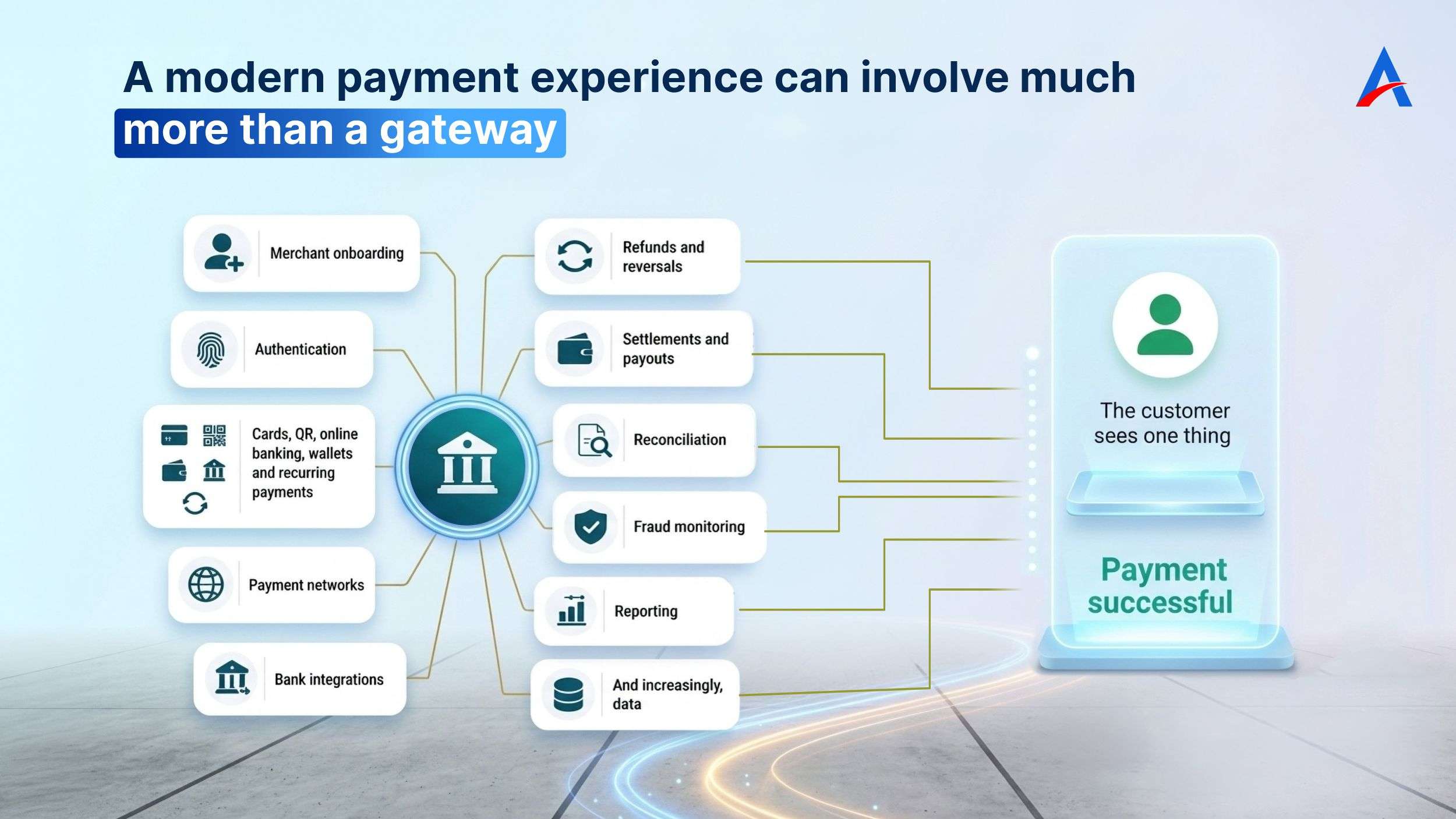
The BFSI has to manage everything behind those two words.
That is why thinking of the payment gateway as simply a transaction-processing component can become limiting.
The gateway is increasingly becoming an operating layer for merchant payments.
The Complexity Is Moving Behind the Checkout
Consider a merchant onboarding 10,000 businesses.
At 100 merchants, manual processes and multiple systems may still appear manageable.
At 10,000 merchants, the same architecture can become an operational problem.
- Who owns the merchant relationship?
- Where does the merchant data sit?
- How quickly can a new merchant be activated?
- How are different payment methods managed?
- Where do settlement records come together?
- How are discrepancies identified?
- How does the bank understand transaction performance?
And perhaps most importantly:
Who owns the data and the economics of the merchant relationship?
These are no longer questions for a payment processor alone.
They are strategic questions for the BFSI.
Part 2: The Bigger Opportunity
Technology readiness is no longer just an IT objective.
It has become a business advantage.
Organisations with modern payment infrastructure can:
But what happens when a BFSI moves beyond simply processing payments and starts thinking about owning the merchant payment ecosystem?
As Malaysia’s payment infrastructure becomes more connected, the opportunity goes beyond accepting more payment methods.
It is about ownership, control, data, operations and the merchant relationship.
In Part 2, we explore with Ascertain what a BFSI-owned payment ecosystem could look like and why the next payment advantage may not be another payment method, but the infrastructure that brings them all together.