

Date
8/April/2026
Share
- Why Resilience Is Now a Daily Requirement?
- How Ascertain Builds Resilient Cloud-Native Operations
- Container Operations: Built to Recover and Scale
- Self-Healing Systems & Incident Automation
- DevSecOps: Resilience Starts Before Production
- Aligned to AWS Well-Architected Principles
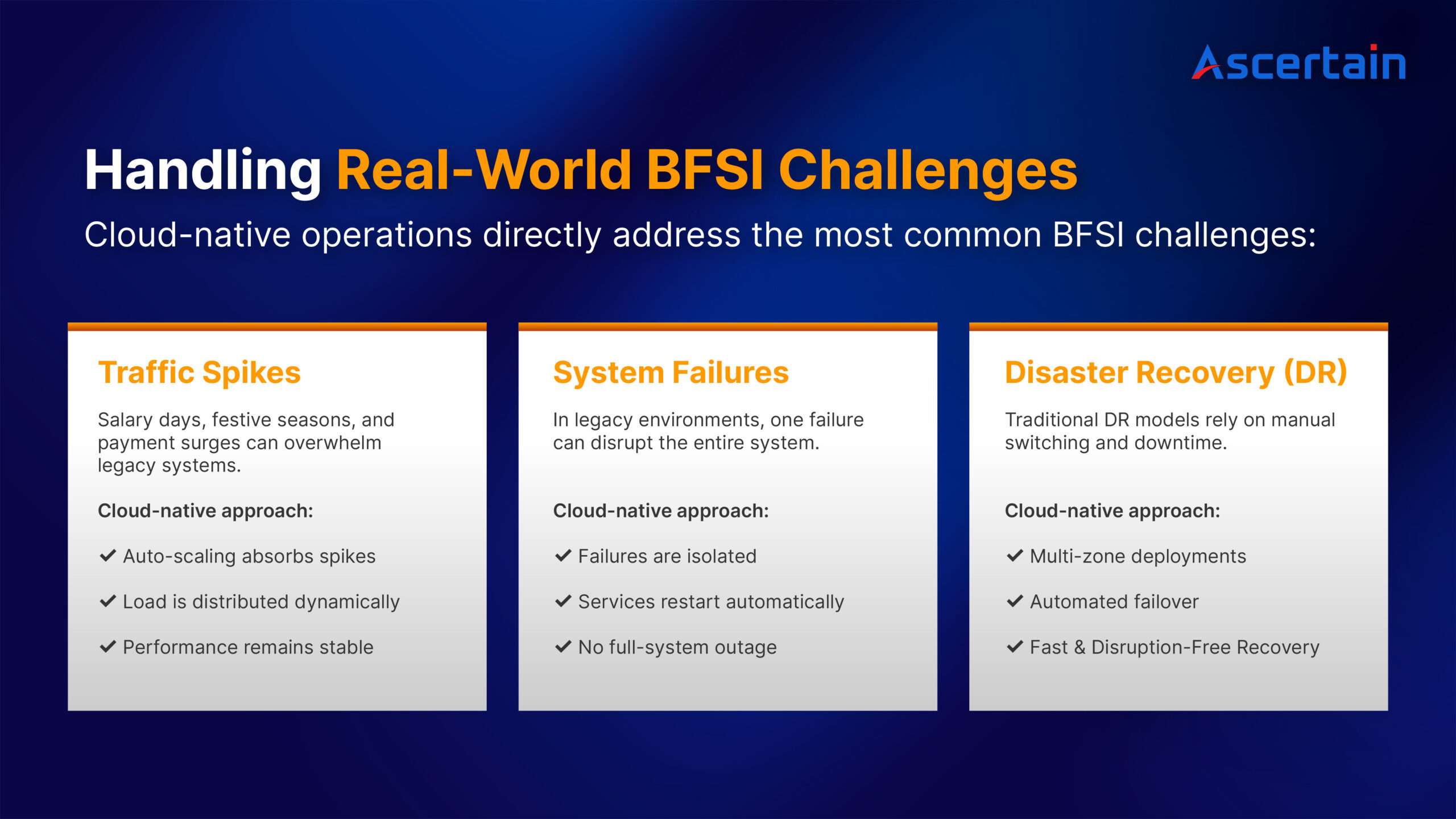
- Handling Real-World BFSI Challenges
- Beyond Technology: Building a Resilient Operating Model
- The Outcome: Resilience That Scales with the Business
- Conclusion
Scaling Resilience: Cloud-Native BFSI Operations
Why Resilience Is Now a Daily Requirement?
Banks and financial platforms today operate in a real-time environment:
- Payments happen instantly (FPX, real-time transfers, wallets)
- Customers expect zero downtime
- Regulators expect continuous availability
- Fraud risks evolve in seconds
Yet many institutions still rely on manual processes, rigid deployments, and reactive incident handling.
The result?
- Slow recovery during outages
- Performance issues during traffic spikes
- Delayed response to system failures
- Operational teams constantly firefighting
Resilience cannot be added later.
It must be built into how systems are operated.
How Ascertain Builds Resilient Cloud-Native Operations
At Ascertain, resilience is not treated as a feature. It is built into how systems are deployed, monitored and continuously improved.
Using AWS cloud-native capabilities, Ascertain helps BFSI institutions move from:
- Reactive operations → Predictable operations
- Manual recovery → Automated recovery
- Fixed systems → Self-healing systems
This is achieved through a combination of containerized workloads, automated pipelines, and continuous monitoring.
Container Operations: Built to Recover and Scale
Modern BFSI systems cannot depend on single-instance deployments.
Ascertain uses container-based platforms (such as Kubernetes on AWS) to ensure:
- Applications run in isolated, manageable units
- Failed components restart automatically
- Traffic is distributed across healthy instances
- Scaling happens without downtime
In high-volume payment environments, this means:
When traffic spikes → systems expand
When a service fails → it is replaced automatically
No manual intervention. No cascading failures.
Self-Healing Systems & Incident Automation
Traditional operations rely on alerts followed by manual fixes.
Cloud-native operations work differently.
Ascertain implements:
- Automated health checks
- Auto-restart mechanisms for failed services
- Event-triggered recovery workflows
- Integrated monitoring dashboards
This ensures:
- Issues are detected early
- Failures are contained quickly
- Recovery happens automatically
In many cases, systems resolve issues before users even notice.
DevSecOps: Resilience Starts Before Production
Resilience is not just about handling failures. It starts with how systems are built and deployed.
Ascertain embeds security, testing, and compliance directly into deployment pipelines:
- Code is validated before release
- Security checks are automated
- Infrastructure is deployed consistently
- Changes are rolled out in smaller, safer increments
This reduces:
- Deployment risks
- Downtime during releases
- Post-release failures
Instead of large, risky updates, BFSI systems move toward continuous, low-risk improvements.
Aligned to AWS Well-Architected Principles
Ascertain’s operational model aligns closely with AWS Well-Architected best practices, especially:
- Operational Excellence
Continuous monitoring, automation, and improvement.
- Reliability
Systems designed to recover automatically and handle failure gracefully.
- Performance Efficiency
Resources scale dynamically based on demand.
- Security
Built into every layer, not added later.
This ensures operations are not just functional, they are predictable and auditable.
Beyond Technology: Building a Resilient Operating Model
Resilience is not just about tools.
It is about how teams operate.
Ascertain enables BFSI organisations to:
- Shift from reactive support to proactive monitoring
- Standardize deployment and recovery processes
- Reduce dependency on manual intervention
- Improve collaboration between development, operations, and security teams
This creates a cloud-native culture, not just cloud infrastructure.
The Outcome: Resilience That Scales with the Business
With Ascertain’s cloud-native operations approach, BFSI institutions can:
✔ Handle high transaction volumes without disruption
✔ Recover from failures automatically
✔ Deploy updates faster and safer
✔ Reduce operational risk
✔ Improve customer trust and experience
Resilience becomes continuous, not situational.
Conclusion
In modern BFSI systems:
Downtime is visible.
Delays are unacceptable.
Failures are costly.
Resilience must be built into operations, not added after incidents.
Cloud-native operations, when implemented correctly, turn uncertainty into control.